

What Is SEO? How Search Engine Optimization Works, Its Types and History

At a glance
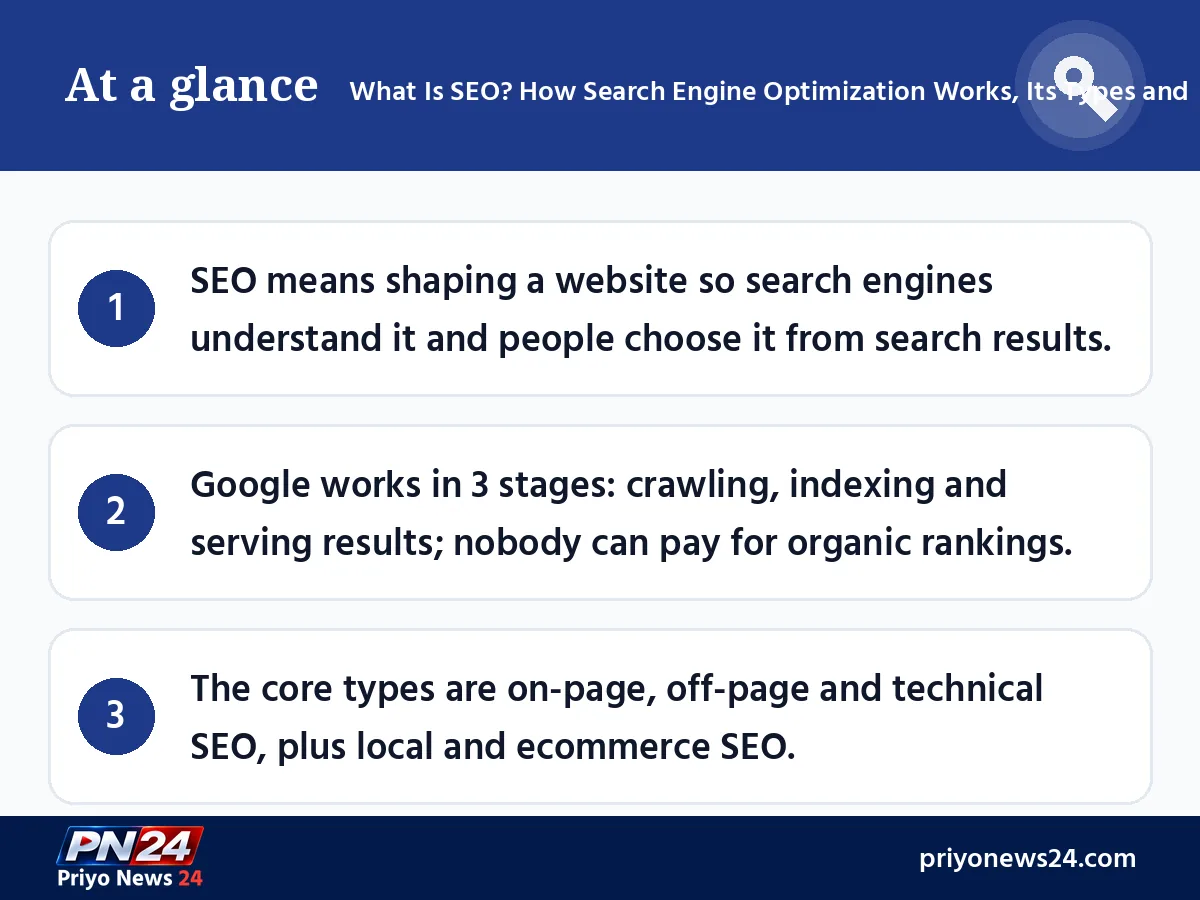
- SEO means shaping a website so search engines understand it and people choose it from search results.
- Google works in 3 stages: crawling, indexing and serving results; nobody can pay for organic rankings.
- The core types are on-page, off-page and technical SEO, plus local and ecommerce SEO.
Type "best laptop shop in Dhaka" into Google and a handful of websites fill the first page. Why those, and not the thousands of others? A big part of the answer is SEO. New bloggers, online shop owners and people learning freelancing all ask the same first question: what is SEO, how does it work, and where do I start? This guide answers those questions in plain English, built on Google's own official documentation.
What is SEO: a simple definition
SEO stands for search engine optimization. Google's SEO Starter Guide describes it as helping search engines understand your content, and helping people decide, from the search results, whether your site is worth a visit.
So SEO is not about tricking Google. It works in two directions: the search engine must be able to read and understand the page, and the reader must be able to tell from the result that the page will answer their question.
In Bangladesh, SEO effectively means Google SEO. According to StatCounter, Google held about 98.46% of the country's search engine market in October 2026, with Bing at about 1.01%. Every example below therefore uses Google.
How SEO works: Google's 3 stages
Google's guide "How Google Search works" breaks search into three stages:
- Crawling: an automated program called Googlebot follows links to find new and updated pages and downloads their text, images and videos. Most new pages are discovered through links from pages Google already knows.
- Indexing: Google analyses what each page is about and stores it in its huge database, the index. When several pages are nearly identical, Google picks one as the "canonical" version.
- Serving results: when someone searches, Google pulls the most relevant and useful pages from its index. Hundreds of factors play a part, including the searcher's location, language and device.
Two points matter. First, Google does not guarantee that any page will be crawled or indexed. Second, Google states plainly that it does not accept payment to crawl a site more often or to rank it higher. Be wary of anyone who promises "page one on Google for a fee".
Types of SEO
By the kind of work involved, SEO is usually split like this:
| Type | Focus | Examples |
|---|---|---|
| On-page SEO | Content on the page | Titles, headings, keywords, image alt text, internal links |
| Off-page SEO | Trust built outside the site | Backlinks, reviews, brand mentions |
| Technical SEO | How the site is built | Speed, mobile-friendliness, sitemap, HTTPS, indexing |
| Local SEO | Location-based searches | Google Business Profile, address, reviews |
| Ecommerce SEO | Online shops | Product pages, categories, product reviews |
There is also a split by method. White hat SEO follows search engine rules and creates content for people; its results last. Black hat SEO relies on deceptive tricks such as hidden text, cloaking or bought links, and risks penalties or removal. Grey hat sits in between.
For a full list of what on-page SEO covers, read our on-page SEO checklist, and to understand keyword types, see types of keywords in SEO.
Ecommerce and marketplace SEO
Whether your shop runs on Shopify, Wix or custom code, the principles are the same. Every product page needs its own clear title, a description you wrote yourself (not the manufacturer's copy), clean photos and readable URLs. Google's guide notes that a meaningful path like /pets/cats.html is more useful to people than a string of random numbers. Inside marketplaces such as Daraz or Amazon, the right keywords in the title, good photos and reviews also shape how products rank in the platform's own search (marketplace SEO).
History of SEO: a quick timeline
- Mid-1990s: as early search engines catalogued the web, webmasters began optimising their sites.
- 1997: according to journalist Danny Sullivan, the phrase "search engine optimization" came into use around this time.
- 1998: Larry Page and Sergey Brin founded Google on the PageRank method, which treats links from strong pages as a major signal.
- 2011 (Panda): sites with duplicated and low-quality content lost rankings.
- 2012 (Penguin): an update aimed at manipulative tactics such as spammy links.
- 2013 (Hummingbird): Google moved towards understanding the meaning of a query, not just its words.
- 2019 (BERT): language models began helping Google interpret searches.
The lesson is clear: every major update weakened shortcuts and rewarded quality content written for readers.
The future of SEO: what is changing
Google now shows AI-generated answers in search, and many people put their questions to ChatGPT or other AI assistants. That has not killed SEO. Sites that offer clear facts, reliable sources, FAQs and named authors stand a better chance of being cited. Google's spam policies (last updated on 28 August 2026) also list "scaled content abuse", meaning mass-producing low-value pages just to rank, as spam. The core rule for the future is unchanged: create content that genuinely helps people.
7 steps to start SEO as a beginner
- Add your site to Google Search Console. It shows which searches surface your site, how often, and which pages have problems.
- Check whether your site is indexed. Search Google for site:yourdomain.com.
- Understand your keywords. Find the exact words your readers type. In Bangladesh, check both Bangla and English searches.
- Give each page a unique title and meta description. Google says titles should be clear, concise and accurate to the page; a meta description is a one- or two-sentence summary.
- Answer the reader's question fully. Don't repeat a keyword over and over: keyword stuffing breaks Google's spam policies. And Google does not use the meta keywords tag at all.
- Add alt text to images and keep the site fast. Many readers are on mobile, so the site must load quickly on a phone.
- Be patient and measure. Effects can take from a few hours to several months to appear; compare results in Search Console after a few weeks.
Mistakes to avoid
- Buying hundreds of backlinks (a breach of Google's link spam policy).
- Copying text from other websites.
- Testing your site only on a desktop, never on a phone.
- Giving up after one month without results.
Final word
The simplest answer to "what is SEO" is this: give searchers the best answer to what they are looking for, and make it easy for Google to understand that answer. The technical details can be learned over time, but that principle has never changed. If your business website needs SEO advice, you can contact Sultan Muhammad Rashed.
Sources: Google Search Central's SEO Starter Guide, How Google Search works and Spam policies; Wikipedia's Search engine optimization article; StatCounter's Bangladesh search engine market data (October 2026). All facts checked on 15 November 2026.
FAQ
What is SEO in simple words?
SEO, or search engine optimization, is the work of improving a website's content and structure so that search engines such as Google can understand its pages and show them in unpaid (organic) search results.
How many types of SEO are there?
By the kind of work there are 3 core types: on-page SEO (content on the page), off-page SEO (links, reviews and mentions elsewhere) and technical SEO (speed, indexing, mobile). Local SEO and ecommerce SEO are often treated separately. By method, people talk about white hat, black hat and grey hat SEO.
How long does SEO take to work?
Google's own SEO Starter Guide says a change can take anywhere from a few hours to several months to show up in search, so it suggests waiting a few weeks before judging the effect.
Can I pay Google to rank first?
Not in organic results. Google states that it does not accept payment to crawl a site more often or rank it higher. Paying only buys ad placements through Google Ads, which is SEM, not SEO.
What is the difference between SEO and SEM?
SEO earns unpaid organic rankings, while SEM means running paid search ads. SEO is slower but lasting; when you stop paying for ads, SEM traffic stops too.
How do I check if my site is on Google?
Search Google for site: followed by your domain, for example site:example.com. If your pages appear, the site is indexed. Google Search Console gives the full picture.
Comments
No comments yet — be the first to comment.