

What Is Off-Page SEO? Backlinks, Reviews and Local SEO — a Safe Step-by-Step Guide

At a glance
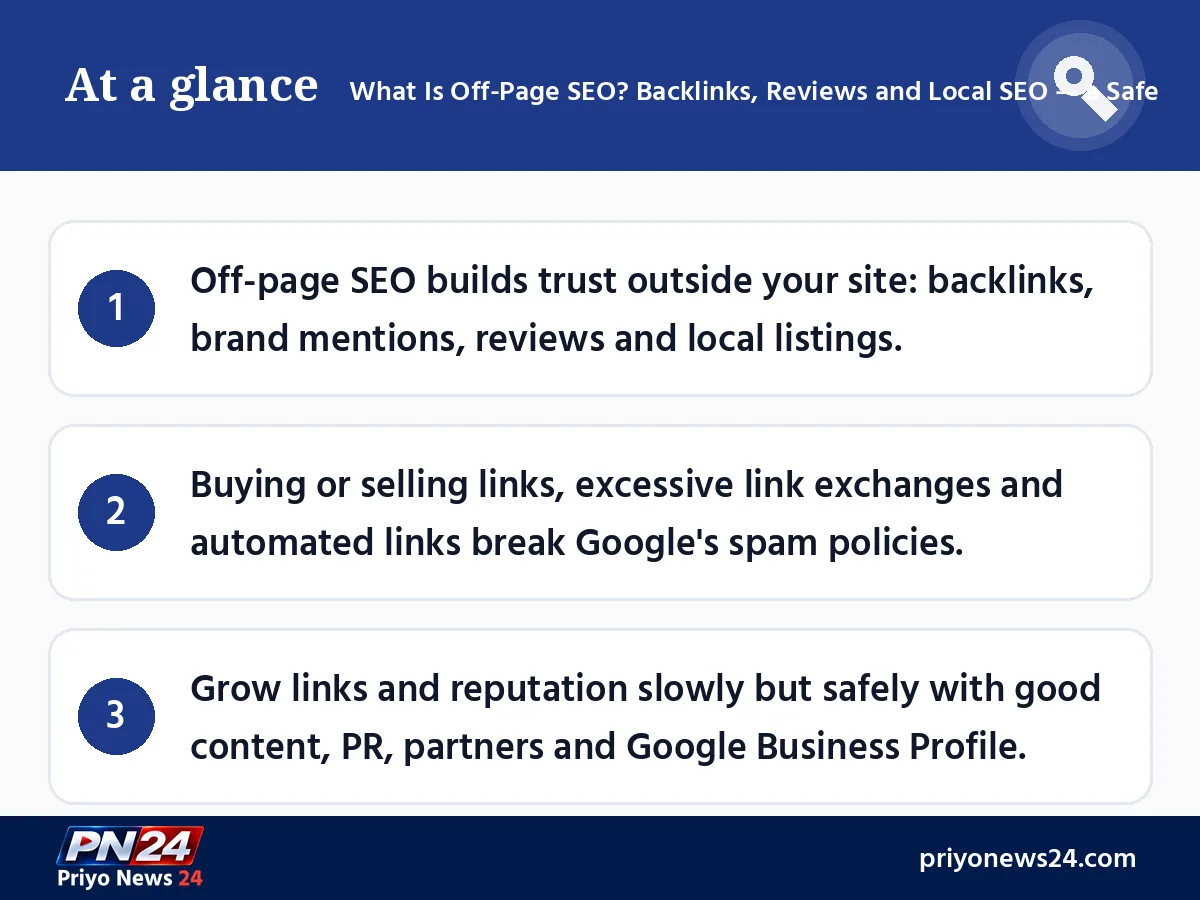
- Off-page SEO builds trust outside your site: backlinks, brand mentions, reviews and local listings.
- Buying or selling links, excessive link exchanges and automated links break Google's spam policies.
- Grow links and reputation slowly but safely with good content, PR, partners and Google Business Profile.
Plenty of people publish excellent articles and get every title and heading right, yet still never reach Google's first page. The reason is that Google looks not only at what your page says, but also at what others say about you. That second part is off-page SEO. This guide explains what off-page SEO is, how it differs from on-page SEO, how to do it safely within Google's rules, and which "shortcuts" can damage your site.
What is off-page SEO
Off-page SEO is everything you do outside your own website to build its credibility and visibility with search engines. As Yoast puts it, the aim is to show search engines that other people trust and recommend your site.
The history explains why. When Google's founders launched it in 1998, it was built on PageRank, whose core idea was that a page linked to by more, and stronger, pages is more important. Google's SEO Starter Guide still says that most new pages are discovered through links from pages Google has already crawled. Links therefore remain at the heart of off-page SEO.
The main parts of off-page SEO:
- Backlinks: links from other websites to yours.
- Brand mentions: references to your name or domain on other sites, even without a link.
- Reviews: customer opinions on Google, Facebook or other platforms.
- Local listings: your name, address and phone number on Google Business Profile and directories.
- Social media: not a direct ranking factor, but it helps content spread and attract links.
On-page SEO vs off-page SEO at a glance
| Point | On-page SEO | Off-page SEO |
|---|---|---|
| Where the work happens | On your own pages | Outside your site |
| Control | Fully yours | Has to be earned |
| Examples | Titles, headings, content, alt text, internal links | Backlinks, reviews, mentions, local listings |
| Key question | What is this page about? | How trustworthy is this page? |
| When to start | First | After you have good content |
Order matters: fix on-page first, then work off-page. Sending links to a weak page only means visitors arrive and leave. For the on-page side, see our on-page SEO checklist, and for the basics, read what is SEO.
Link tactics that put you at risk: Google's link spam policy
Knowing what not to do comes first, because offers of hundreds of cheap backlinks are easy to find online. Google's spam policies (last updated 28 August 2026) give these examples of link spam:
- Buying or selling links for ranking, for money, goods, services or free products.
- Excessive link exchanges or "partner pages" built only to cross-link.
- Using automated programs or services to create links.
- Links from low-quality directory or bookmark sites.
- Forum comments or signatures stuffed with optimised links.
- Paid guest posts, advertorials or press releases with links that pass ranking credit.
- Links spread widely across other sites' footers or templates.
Buying links for advertising or sponsorship is allowed, but those links must carry rel="sponsored" or rel="nofollow". Google's guide also says links in user comments on your own site should get nofollow or a similar annotation. According to Wikipedia, the 2012 Penguin update targeted exactly this kind of manipulative linking.
8 safe ways to earn backlinks
- Create content worth linking to. Your own data, a small survey, comparison tables, free templates or a complete guide that others will want to cite.
- Fix your profiles in places you already belong. Check that business associations, chambers, partner companies and suppliers list your organisation correctly, with a link.
- Do digital PR. Tell the media about new products, achievements or projects; real news brings natural mentions and links.
- Offer expert comment. Journalists and bloggers often look for expert views; accurate, useful input earns named mentions.
- Find and fix broken links. If you delete an old page or change its URL, links pointing to it break. Add a redirect or ask the site owner to update the link.
- Turn unlinked mentions into links. When someone mentions your brand without linking, a polite request often gets a link added.
- Write genuine guest articles. Contribute truly useful pieces to relevant sites in your field, never paid posts with keyword links.
- Share content on social media and in communities. Answer questions instead of spamming links, and share your guide where it truly helps. The more people see it, the better the chance of natural links.
Local off-page SEO: the biggest win for small businesses
For a restaurant in Dhaka, a clinic in Chattogram or a coaching centre in any district, Google Business Profile is the most powerful off-page SEO tool. According to Google's help page, local results depend mainly on three things:
- Relevance: how well your profile matches the search, so fill in categories, hours and services completely and accurately.
- Distance: how far the searcher is from your business.
- Prominence: how many websites link to your business and how many reviews you have; more reviews and better ratings help.
Google states plainly that there is no way to request or pay for a better local ranking. So ask happy customers for reviews, reply politely to every one, and keep the same name, address and phone number on your website, Facebook page and directories. Never use fake reviews.
How to measure off-page SEO
- Google Search Console: the Links report shows which sites link to you and which of your pages attract the most links.
- Branded searches: check in Search Console whether more people are searching for your brand name.
- Referral traffic: how many visitors arrive through links on other sites.
- Review count and rating: compare month by month.
Note these four numbers once a month, and put more time into whatever brings good links or visitors.
A 4-week plan for a new site
| Week | Task |
|---|---|
| 1 | Make your name, address and phone identical on Google Business Profile and your Facebook page; set up Search Console |
| 2 | Build your single best guide or template, something others will want to reference |
| 3 | Check your profile and link on partner, supplier and association websites |
| 4 | Ask 10 past happy customers for a review and reply to each one |
Final word
Off-page SEO is not a race to collect links; it is about earning a reputation. People link to you, review you and mention you only when your work is worth mentioning. So focus first on the quality of your content and service, then on getting known. If your business needs a safe link-building and SEO plan, you can contact Sultan Muhammad Rashed.
Sources: Google Search Central's Spam policies and SEO Starter Guide, Google Business Profile Help's local ranking page, Yoast's off-page SEO guide and Wikipedia's Search engine optimization article. All facts checked on 15 November 2026.
FAQ
What is off-page SEO?
Off-page SEO is the work done outside your own website to build its credibility and visibility with search engines, such as earning backlinks from other sites, brand mentions, online reviews and accurate local directory listings.
What is the difference between on-page and off-page SEO?
On-page SEO is work on your own pages: content, titles, headings, images and internal links. Off-page SEO happens outside your site: whether others link to or mention you, and what your reviews say. On-page is fully in your control; off-page has to be earned.
Is it safe to buy backlinks?
No. Buying or selling links for ranking, whether for money, goods or services, is listed as link spam in Google's spam policies. Links bought for advertising or sponsorship must carry rel="sponsored" or rel="nofollow".
Does social media help off-page SEO?
Social shares are not treated as a direct Google ranking factor, but they help content reach more people, which can lead to links, branded searches and recognition that help indirectly.
How do I do off-page SEO for a local business?
Complete your Google Business Profile accurately, keep your name, address and phone number consistent everywhere, ask happy customers for reviews and reply to them. Google says local ranking depends on relevance, distance and prominence, and that there is no way to pay for a better local ranking.
How long does off-page SEO take to show results?
There is no fixed timeline. Good links and reviews build up slowly and Google also takes time to process changes. Usually the effect becomes visible after a few months of steady work.
Comments
No comments yet — be the first to comment.