

Digital Marketing Trends 2026: Which of 40 Old Trends Still Work

At a glance
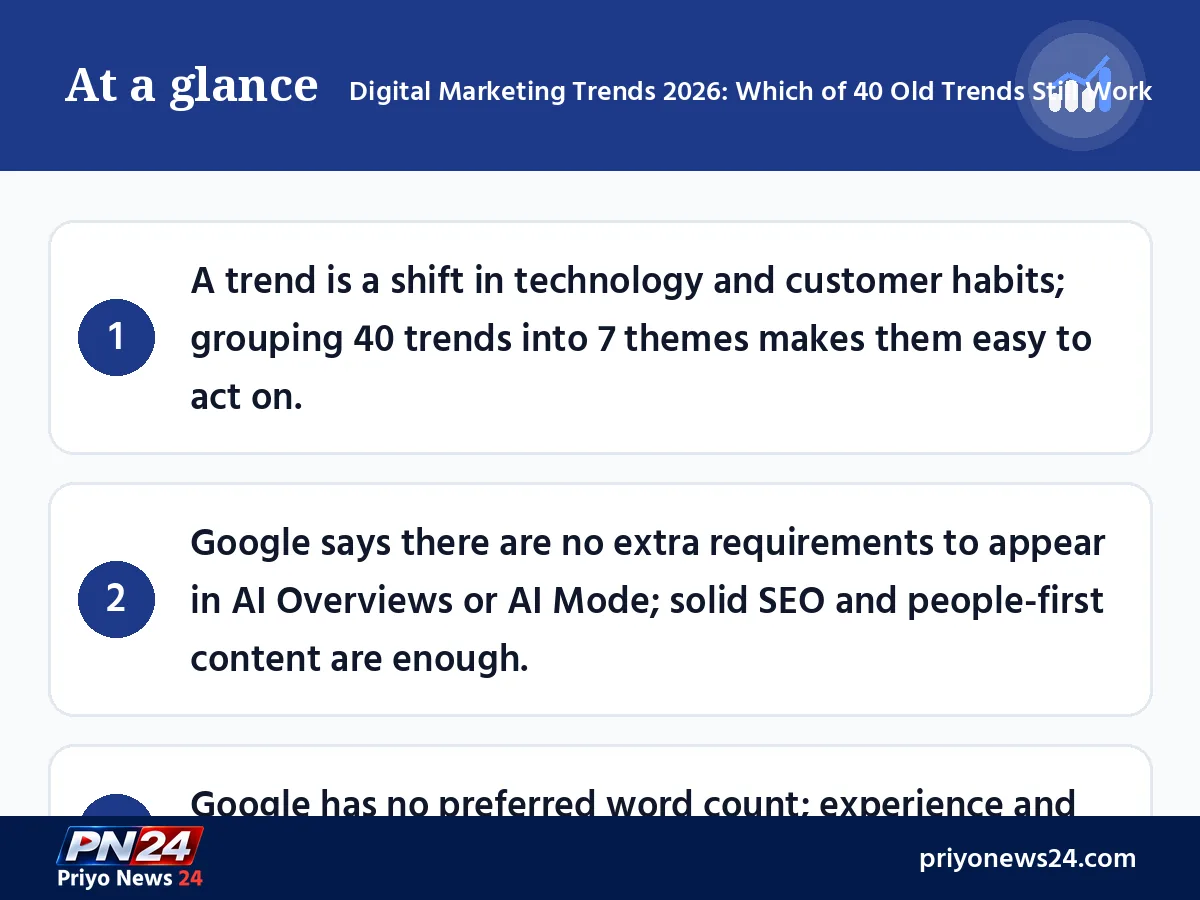
- A trend is a shift in technology and customer habits; grouping 40 trends into 7 themes makes them easy to act on.
- Google says there are no extra requirements to appear in AI Overviews or AI Mode; solid SEO and people-first content are enough.
- Google has no preferred word count; experience and trust (E-E-A-T) matter more than long articles.
Digital marketing trends change every year. A few years ago Sultan Muhammad Rashed wrote a long list of 40 trends for marketers and SEOs: AI, voice search, featured snippets, video, chatbots, social commerce, TikTok, first-party cookies and even Google's question-discovery tools. A lot has happened since. This guide re-checks those 40 trends with facts as of November 2026: which ones grew stronger, which ones changed, and which ones are gone.
What a digital marketing trend really is
A digital marketing trend is a key change in the digital media industry. It has two sides: customer demand and habits shifting, and new technology that makes work easier. In Sultan Muhammad Rashed's words, it is less a "change" than an industry "update" that happens a little every day.
Knowing the trends matters because the tactic that worked last year can quietly become expensive this year. But you don't need to chase every trend. Pick the ones that fit your business, budget and where your customers actually spend time.
40 trends in 7 themes: one table
The 40 names on the old list look separate, but many belong to the same big shift. Here they are grouped, with their status today.
| Theme | Trends from the old list | Status in 2026 |
|---|---|---|
| AI and automation | AI, chatbots, automation, conversational marketing, smart bidding | Stronger; now built into almost every tool |
| Search | Voice search, featured snippets, alternative search engines, multilingual SEO, unanswered searches | Changed: AI answers added |
| Content quality | Long content, E-A-T, real stories, case studies, interactive content, segmentation | E-A-T became E-E-A-T; word-count myth corrected |
| Video and audio | Video content, short/DIY video, live streaming, stories, podcasts | Short video is now mainstream |
| Social and commerce | Social commerce, TikTok, messaging apps, mobile commerce, voice commerce, visual search | Facebook-based selling is huge in Bangladesh |
| Advertising | Facebook ads, programmatic, native, IoT ads, push notifications | AI-driven targeting has grown |
| Trust and foundations | Accessibility, ethical link building, unique brand, green marketing, first-party cookies, B2B, R&D, 5G | The most important for the long run |
1. AI and automation: still trend number one
AI sat at the top of the old list, and that call proved right. Back then the article listed specific AI writing tools; many of those names and features have changed, so we don't repeat the list here. The core point stands: AI speeds up drafting, proofreading, keyword research, competitor analysis and email automation.
- Chatbots and conversational marketing: customers ask on Messenger or your website and get an instant reply. For a small shop, automatic answers to "what's the price?" or "when will it arrive?" save hours.
- Automation: order confirmations, follow-up messages and email sequences run on their own once set up.
- Smart bidding: on Google and Meta ads, machine learning now decides who sees your ad and at what price. Your job is to set the right goal (sales, leads) and feed it accurate conversion data.
One warning: Google's helpful-content guidance says that producing lots of text with generative AI and no human oversight "represents little to no effort", and using automation mainly to manipulate rankings breaks its spam policies. AI is the assistant; you are the author.
If you sell online, AI can now help inside your e-commerce platform itself. For example, eCommerce Autopilot, an all-in-one e-commerce SaaS from Bangladesh, includes Autopilot AI for products, customer replies and business tasks, alongside a ready website, order and courier management.
2. Search has changed: voice, snippets and AI answers
Search used to mean ten blue links. Voice search taught people to ask long, question-style queries, which made long-tail keywords more important. Featured snippets, or "position zero", then put a direct answer above the first link.
Now Google has added AI Overviews and AI Mode: AI-generated answers with links to supporting websites. Many people assume these need a brand-new tactic. Google's own guide says there are no additional requirements to appear in them; a page only needs to be indexed and eligible to show with a snippet. No special markup or AI-specific text files are needed.
What helps:
- Answer the question directly in the first paragraph, then go into detail.
- Use real reader questions as ## headings and add an FAQ.
- Put important information in text, not only in images.
- If you use structured data, make sure it matches the visible text.
Multilingual SEO is a big opportunity in Bangladesh. Bangla searches keep growing, but good Bangla content is still scarce. Offering Bangla and English versions of the same page reaches both audiences.
Unanswered searches: the old article recommended Google's question-discovery tool, which showed questions without good answers. Google's Question Hub closed in January 2023. Today you can do the same job with Search Console's queries report, Google's "People also ask" box and autocomplete suggestions.
3. Content quality: experience beats length
One old trend was "unique long content": the idea that writing more words than competitors earns rankings. Today's facts correct this. Google states it has no preferred word count. Use as many words as it takes to fully answer the question, and no more.
E-A-T is now E-E-A-T: Experience, Expertise, Authoritativeness and Trustworthiness, with trust described as the most important. That makes three old trends even more valuable:
- Telling a real story: genuine experience from your business or work, including mistakes and lessons.
- Real case studies: the problem, what you did and the result, with numbers.
- Content segmentation: separate content for beginners, experts, buyers and sellers.
Interactive content (quizzes, calculators, polls) turns readers into participants. A small loan calculator or price-comparison tool often gets shared more than a long article.
4. Video and audio: short video is mainstream
Video combines voice, images and text, so it is the richest form of content. The old video SEO tips still hold: choose a focus keyword before recording, say it early in the video, add subtitles and write a strong description.
Short and DIY videos (Reels, Shorts, TikTok) were rising then and are central on every platform now. Live streaming is popular in Bangladesh, especially Facebook Live product demos. Stories suit short-lived offers and behind-the-scenes moments. Podcasts and audio reach people who listen while they work or travel.
5. Social commerce and mobile: the Bangladesh reality
In Bangladesh, many businesses start with a single Facebook page. Social commerce means people discover, ask about and buy products inside social media. Messaging apps such as Messenger and WhatsApp act like the shop counter, so fast replies often decide whether you win or lose a sale.
Mobile commerce is no longer a separate trend; it is the default. If your page or website is slow on a phone, customers leave. Voice commerce and visual search (finding products by photo) are growing, so use clear product photos and precise names and descriptions.
Don't depend only on a Facebook page. Having your own website is safer, because customers can still find you if a page is restricted or its reach drops.
6. Advertising: from Facebook ads to programmatic
Facebook (Meta) ads remain the easiest paid channel for small businesses. Programmatic advertising means software buys ad space automatically. Native ads look like regular content and feel less intrusive, but the "sponsored" label must always be clear. Push notifications bring back past readers and customers, though people switch them off if you send too many. IoT ads (on smart TVs and other connected devices) are more relevant for big brands.
7. Trust, privacy and foundations
First-party data: for years marketers heard that Chrome would remove third-party cookies. In October 2025 Google said Chrome will keep its current approach of offering users a choice about third-party cookies, and that it is retiring several Privacy Sandbox technologies, including Topics and Protected Audience, because of low adoption. The lesson hasn't changed: your own email list, customer phone numbers (with permission) and your own analytics are your most reliable assets.
Accessibility: a website must work for everyone. WCAG's four principles (POUR) are Perceivable, Operable, Understandable and Robust, and the current version is WCAG 2.2. Start with image alt text, enough colour contrast and buttons that work with a keyboard.
Ethical link building and a unique brand: earn links naturally through good content (white-hat SEO) instead of buying or spamming them, and build a brand people search for by name.
Green marketing, B2B and research: keep any eco-friendly claims true and provable. In B2B, LinkedIn, case studies and expert content work well. And regularly testing against your own data (A/B tests) is the most practical "research and development". Faster 5G networks make video and live content easier to deliver.
Where to start: priorities for a small business
| Priority | What to do | Cost |
|---|---|---|
| 1 | Fast mobile website or page, clear product photos | Low |
| 2 | 3-4 short videos a week | Low |
| 3 | Fast message replies, a chatbot if needed | Low to medium |
| 4 | Question-and-answer blog posts and FAQs in Bangla | Low |
| 5 | Your own customer list and email/message follow-ups | Low |
| 6 | Small-budget tests of Facebook or Google ads | Medium |
Common mistakes: jumping onto every new platform at once, publishing AI text without reading it, chasing follower counts instead of sales, and relying entirely on one platform without keeping your own data.
If you want personal advice on which trends your business should adopt first, you can reach marketing consultant Sultan Muhammad Rashed.
Final word
A list of 40 trends can feel overwhelming, but they boil down to three ideas: be where your customers are (mobile, video, messaging), publish content that genuinely helps, and build your own customer trust and data. AI makes all of this faster, but it cannot replace real experience and honesty.
FAQ
What is a digital marketing trend?
It is a major shift in how customers behave online or in the technology marketers use, such as AI tools, short-form video, or buying directly through social media.
What is the biggest digital marketing trend in 2026?
AI. It now shapes content drafts, customer replies, ad bidding and even search results. But Google treats mass-produced AI content without human oversight as low-effort, so human experience and fact-checking still matter.
How do I get my site into Google's AI Overviews?
According to Google's own guide, there are no additional requirements. The page must be indexed and eligible to show with a snippet, and you should follow normal SEO basics: allow crawling, use internal links, offer a good page experience and keep key information in text.
Do longer articles rank better on Google?
No. Google states it has no preferred word count. Write as much as you need to fully answer the reader's question; padding an article can hurt rather than help.
Have third-party cookies gone away?
Not as of November 2026. In October 2025 Google said Chrome will keep its current approach of giving users a choice about third-party cookies, and that it is retiring several Privacy Sandbox technologies because of low adoption. Building your own email list and customer data is still the safest path.
Which trends should a small business start with?
A fast mobile-friendly website or page, short videos, quick replies on Messenger and WhatsApp, and your own customer list. These are cheap to start and show results quickly.
Sources
- Google Search Central — AI features and your website
- Google Search Central — Creating helpful, reliable, people-first content
- Privacy Sandbox — Update on plans for Privacy Sandbox technologies
- MDN — Understanding the Web Content Accessibility Guidelines
- Search Engine Land — Google Question Hub to close down
Comments
No comments yet — be the first to comment.