

The Key to Digital Marketing Success: 10 Mistakes Holding You Back

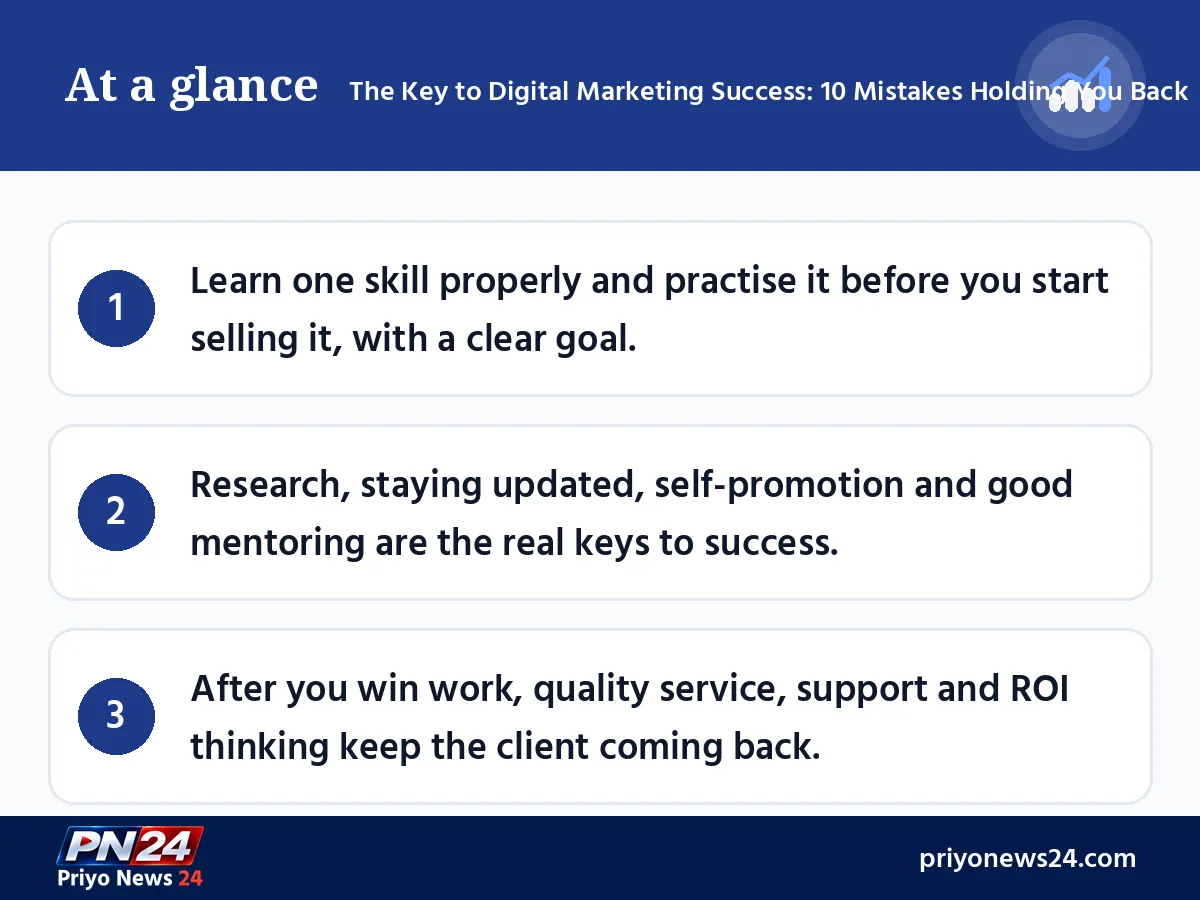
At a glance
- Learn one skill properly and practise it before you start selling it, with a clear goal.
- Research, staying updated, self-promotion and good mentoring are the real keys to success.
- After you win work, quality service, support and ROI thinking keep the client coming back.
The key to digital marketing success is not a secret trick. Most people who last in this profession simply avoid a handful of common mistakes, while those who try for a few months and disappear tend to fall into the same traps. These mistakes show up at every stage: learning, winning work and keeping it.
Sultan Muhammad Rashed has advised beginners on digital marketing and freelancing for many years. Drawing on the core ideas from one of his webinars, this guide sets out those 10 mistakes and how to fix them, plus five mistakes people make after landing work and a practical plan for getting started.
Why many people fail to succeed in digital marketing
Getting into digital marketing is easy: a phone or laptop and an internet connection are enough. That low barrier is part of the problem. Many people jump in hoping for quick income and lose heart when nothing happens in a few weeks. Yet the issue is usually not talent but method. Recognising the mistakes below will help you see where you stand.
10 big mistakes on the road to digital marketing success
1. Starting on impulse without experience
"So-and-so has done so much; let me see if something works for me too, and if not, never mind." That mindset is the most dangerous one. Learn one skill properly first. Then practise it again and again until you are confident it is ready for a paying client. While learning, do a small free project for yourself or a local business you know. That becomes your first portfolio piece.
2. No clear goal or mission
Decide which work you really want to do: SEO, Facebook ads, content, email marketing or something else. If you cannot enjoy the work, it is hard to keep going for long. Think through how far you want to go, what you will do when frustration hits and how you will stay the course, and write it down. Set measurable goals for 6 months and 1 year, such as "3 portfolio projects" or "my first 2 clients".
3. Drifting away from the goal and wasting time
Without deciding how many hours a day you will practise and on what, time slips away on social media and pointless videos. Notifications and the instant reward of scrolling steal your focus. The fix: block a fixed part of the day only for learning and practice, switch off notifications during that time, and write two lines at the end of each day about what you learned.
4. Not spending enough time on research
Good marketing starts with research: who the buyers are, what they search for, what competitors do and which keywords have demand. Ads or content created without research often waste both money and time. Before every job, spend at least some time analysing the market and the competition.
5. Not keeping up with new rules
Platform rules change constantly. In 2026 alone, Google released two broad core updates, in March and May, plus a separate Discover core update in February. Sticking to old tactics means falling results. Make a habit of reading Google's official Search Central blog and each platform's help pages.
6. Not promoting yourself enough
Skill alone does not bring work if nobody knows about it. Share samples, case studies and what you are learning regularly on LinkedIn, Facebook or your own website. If a marketer cannot market themselves, clients find it hard to trust them.
7. Lack of proper mentoring
Learning alone means a lot of time on wrong paths. An experienced mentor can show you which skills matter first, where you are going wrong and how to set prices. For advice on business or a marketing career, you can get in touch through Sultan Muhammad Rashed's website.
8. Offering only generic services
Saying "I do digital marketing" makes you one face in a huge crowd. Be specific instead: "Facebook ads for online clothing shops" or "local SEO for clinics". When you solve a specific problem, clients quickly see why you are different.
9. Giving up too easily
Getting no work for the first few months is completely normal. People who succeeded also faced many rejections at the start. Do not quit; learn from every rejected proposal and adjust your profile, portfolio or pitch.
10. Failing to motivate the buyer
Clients do not hire you because you name tools; they want to know what their business gains. In your proposal, restate their problem in your own words, show the steps of your solution and prove it with results from earlier work.
5 mistakes that cost you work even after you land it
| Mistake | Result | Fix |
|---|---|---|
| Not delivering quality service | Bad reviews, lost work | Take on only what you can do well |
| No support after delivery | Clients do not return | Offer a short period of free minor support |
| Ignoring campaign ROI | Client cannot see the value | Report spend against sales or leads |
| No proper marketing strategy | Scattered work, weak results | Write down goals, audience, channels and budget |
| Not retaining clients | Always hunting for new ones | Keep in touch, send monthly reports, bring new ideas |
A practical plan to get started
Once you know the mistakes, here is a simple order to begin:
- Understand how social media works: who uses which platform and what content spreads.
- Build a LinkedIn profile: a clear photo, a specific headline and work samples.
- Join networking groups: ask questions and help others; much work comes through relationships.
- Start blogging: write about what you learn; it deepens your learning and builds a portfolio.
- Learn to read data: get comfortable with Google Analytics and Meta reports.
- Take some online courses: free courses from Google, Meta or HubSpot are a good start.
- Learn basic code: knowing HTML and simple website structure helps a lot with SEO and landing pages.
- Company or agency: decide whether to take a job, join an agency or freelance, based on your situation.
If you want to learn marketing hands-on by running your own online shop, a platform such as eCommerce Autopilot, with a ready website plus order and courier management, lets you open a store quickly. Campaigns you run for your own shop can become your strongest case study.
Common questions
The FAQ below answers what beginners ask most often: how long success takes, whether you need a mentor, how to keep clients and how to stay updated on Google changes.
Final word
The key to digital marketing success fits in three words: learn, persist, deliver. Build the skill first, set a goal, practise for a fixed time every day, and once you win work, treat the client's business results as your own success. Pick one of the 10 mistakes above and start fixing it today. Small changes make a big difference over time.
FAQ
How long does it take to succeed in digital marketing?
There is no fixed timeline. With regular practice, most people reach a usable level in one channel within a few months to a year. Lasting success comes once you have real results, a portfolio and clients who trust you.
What is the biggest mistake beginners make in digital marketing?
Starting on impulse without learning the skill properly, just because someone else seems to be succeeding. Close behind are having no goal, losing hours on social media, and giving up too early.
Can I learn digital marketing without a mentor?
Yes, but it usually takes longer and involves more mistakes. An experienced mentor can show you which skills to learn first, where you are wasting time and how to talk to clients, which shortens the path a lot.
What is the best way to keep clients?
Deliver quality work on time, offer support after delivery, and report clearly what the client got back for the money spent (ROI). When clients see their business growing because of your work, they return.
How do I stay updated on Google changes?
Follow the official Google Search Central blog and the Search Status Dashboard, and watch the official Facebook and YouTube help pages for policy changes. Make reading updates a weekly habit.
Comments
No comments yet — be the first to comment.