

Niyyah for Fasting: Meaning, Arabic Text, Timing and Rules

At a glance
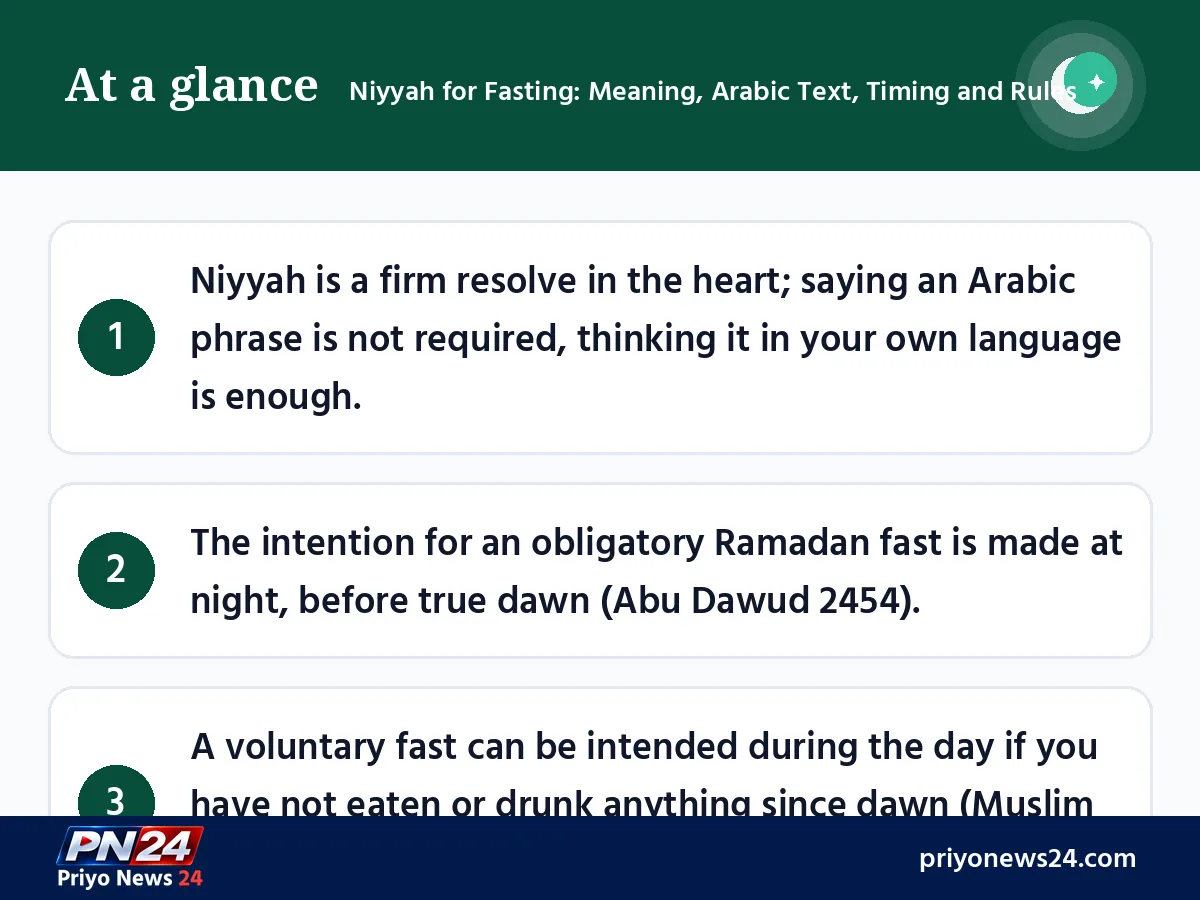
- Niyyah is a firm resolve in the heart; saying an Arabic phrase is not required, thinking it in your own language is enough.
- The intention for an obligatory Ramadan fast is made at night, before true dawn (Abu Dawud 2454).
- A voluntary fast can be intended during the day if you have not eaten or drunk anything since dawn (Muslim 1154).
Every Ramadan, one of the most searched questions in Bangladesh is how to make the niyyah for fasting. Some people try hard to memorise an Arabic sentence; others worry that the fast will not count unless they say it in Arabic. This guide explains what the intention for fasting really is, when to make it, the meaning of the common Arabic intention, how to intend a voluntary fast, what kaffarah is, and which dua to read at iftar. Every hadith comes with its number so you can check it yourself.
What the niyyah for fasting is and why it matters
Fasting in Ramadan is one of the five pillars of Islam. It is obligatory for every adult, healthy Muslim man and woman who is not travelling. For the fast to be valid, intention is a basic condition.
Niyyah means intention or resolve. In the very first hadith of Sahih al-Bukhari, the Prophet (peace be upon him) said that actions are judged by intentions, and every person will get what they intended (Bukhari 1). Simply going without food is not a fast; the conscious decision to fast for the pleasure of Allah is what turns it into worship.
Three key points about the intention:
- The intention is made in the heart, not on the tongue. A decision in your mind is enough.
- You should be clear which fast you are keeping: Ramadan, a make-up (qada) fast, a vowed fast or a voluntary one.
- The intention for an obligatory fast must be made before true dawn (subh sadiq), when the Fajr time begins.
Must the intention be said aloud?
Many people believe the fast is invalid without a specific Arabic sentence. That is a misconception. There is no report that the Prophet (peace be upon him) or his companions said the fasting intention aloud. The Arabic intention common in our society was composed later by people; it has no source in the Quran or hadith.
Think of a simple example. You decide to take the 10 am bus to Dhaka tomorrow. Do you need to announce, "I now intend to travel to Dhaka"? No. You decide, buy a ticket and leave on time. In the same way, when you crave a plate of hot kacchi biryani, you buy it or cook it; you do not make a speech before eating. The wish in your mind is the intention.
Fasting is the same. If you think at night, "I will fast tomorrow for Ramadan, for the sake of Allah, insha'Allah," and then get up for suhoor, that is your sincere intention. You can think it in Bangla, English or any language you think in.
Saying the intention aloud does not break or spoil the fast, and some scholars consider it preferable. The problem is treating it as compulsory, or believing that the fast fails without the Arabic words. Such a belief adds something to the religion that is not part of it, so avoid it.
The common intention: Arabic, transliteration and meaning
For those who want to say it or know its meaning, here is the commonly used intention. Again, memorising or reciting it is not required.
Arabic:
نَوَيْتُ اَنْ اَصُوْمَ غَدًا مِّنْ شَهْرِ رَمَضَانَ الْمُبَارَكِ فَرْضًا لَّكَ يَا اللهُ فَتَقَبَّلْ مِنِّىْ اِنَّكَ اَنْتَ السَّمِيْعُ الْعَلِيْمُ
Transliteration: Nawaitu an asuma ghadan min shahri Ramadanal mubaraki fardan laka, ya Allahu fataqabbal minni, innaka antas Sami'ul Alim.
Meaning: O Allah, I intend to keep tomorrow's obligatory fast of the blessed month of Ramadan for You. So accept it from me. Surely You are the All-Hearing, the All-Knowing.
A simple version you can think in your own words: "O Allah, I intend to keep tomorrow's Ramadan fast for Your sake; please accept it."
When to make the intention
Obligatory fasts
The Prophet (peace be upon him) said, "He who does not determine to fast before dawn does not fast" (Sunan Abi Dawud 2454, graded sahih by al-Albani). So it is best and safest to make the intention for a Ramadan fast at night, before true dawn. Any time from iftar until the end of suhoor works.
You may keep eating and drinking after making the intention until true dawn; it does not affect the intention. Verse 187 of Surah Al-Baqarah allows eating and drinking until the white thread of dawn becomes distinct.
In the Hanafi school, if someone forgot to intend at night and has not eaten or drunk since dawn, intending before the Islamic midday (half of the daytime) makes the Ramadan fast valid. Other schools require a night-time intention for obligatory fasts. For make-up, expiation and vowed fasts, all schools require the intention at night.
A fresh intention every day
According to most scholars, including the Hanafi school, each fast is a separate act of worship and needs its own intention. Some scholars accept one intention at the start of the month for the whole month. To be careful, renew it every night. Eating suhoor with the purpose of fasting is itself proof of the intention.
Timing at a glance
| Type of fast | When to intend | Note |
|---|---|---|
| Obligatory Ramadan fast | At night, before true dawn (best) | Hanafi view: if forgotten, before midday |
| Make-up (qada) fast | At night, before true dawn | Be clear which missed fast it replaces |
| Vowed and expiation fasts | At night, before true dawn | Must be intended specifically |
| Voluntary (nafl) fast | At night or during the day | Only if nothing was eaten or drunk since dawn |
Intention for a voluntary fast
Voluntary fasting is easier. Aisha (may Allah be pleased with her) reported that the Prophet (peace be upon him) came home one day and asked whether there was anything to eat. When told there was nothing, he said, "Then I am fasting" (Sahih Muslim 1154). From this, scholars say a voluntary fast can be intended during the day, as long as you have not eaten or drunk since dawn.
The intention is again in the heart: "I am keeping a voluntary fast today for the sake of Allah." Fasting on Mondays and Thursdays, the "white days" (13th, 14th and 15th of each lunar month), Ashura, the Day of Arafah and six days of Shawwal are all voluntary fasts established in hadith.
Shab-e-Miraj and Shab-e-Barat fasts
No specific fast for Shab-e-Miraj is proven in authentic hadith. Scholars differ about fasting the day after Shab-e-Barat, but fasting often in Sha'ban and fasting the white days are established Sunnah. So there is no need to search for a "special intention"; intend it in the heart like any voluntary fast.
Why a sincere intention matters
Why you fast is the real substance of your intention. A Muslim fasts only to please Allah. If someone goes hungry to lose weight or to be praised by others, there is a wish, but it is not a sincere intention, and worship done for show loses its reward.
So at the start of the fast, ask yourself: for whom am I fasting? Gaining taqwa, following the Sunnah of the Prophet (peace be upon him) and hoping for Allah's forgiveness are the right goals of fasting.
Make-up fasts and kaffarah
Qada means one fast in place of one missed fast. If you miss a Ramadan fast because of illness, travel or another valid reason, you make it up later.
Kaffarah (expiation) is heavier. It is due when someone deliberately breaks a Ramadan fast through marital intercourse. In Sahih al-Bukhari 1936, the Prophet (peace be upon him) gave three options in order:
- Free a slave (not possible today).
- If unable, fast two consecutive months (60 fasts).
- If unable to do that, feed 60 poor people (in the Hanafi view, two full meals each).
In the Hanafi school, deliberately eating or drinking during a Ramadan fast also requires kaffarah; other schools require only a make-up fast and repentance in that case. For detailed rulings, speak to a trusted scholar.
The virtues of Ramadan in brief
- When Ramadan begins, the gates of Paradise are opened, the gates of Hell are closed and the devils are chained (Sahih al-Bukhari 1899).
- The Quran was revealed in this month (Surah Al-Baqarah, verse 185).
- Laylatul Qadr falls in this month and is better than a thousand months (Surah Al-Qadr, verse 3).
- Whoever fasts Ramadan with faith and hope of reward has past sins forgiven (Sahih al-Bukhari 38).
- An Umrah in Ramadan is described in hadith as equal in reward to Hajj (Sahih al-Bukhari 1863).
The dua at iftar
Iftar is a time when duas are hoped to be accepted. After breaking his fast, the Prophet (peace be upon him) used to say:
ذَهَبَ الظَّمَأُ وَابْتَلَّتِ الْعُرُوقُ وَثَبَتَ الْأَجْرُ إِنْ شَاءَ اللَّهُ
Transliteration: Dhahabaz-zama'u wabtallatil-'uruqu wa thabatal-ajru in sha' Allah.
Meaning: The thirst is gone, the veins are moistened, and the reward is confirmed, if Allah wills. (Sunan Abi Dawud 2357)
Many people also say "Allahumma laka sumtu wa 'ala rizqika aftartu" (O Allah, I fasted for You and I break my fast with Your provision). It is reported in Abu Dawud (2358) with a mursal chain, which many hadith scholars consider weak; scholars note there is no harm in reading it as a general dua because its meaning is good.
Common mistakes about the intention
- Thinking the fast fails without Arabic. The intention is in the heart, in any language.
- Thinking you cannot eat after intending. You may eat and drink until true dawn.
- Thinking you cannot fast if you missed suhoor. Suhoor is Sunnah, not a condition. With a night-time intention, the fast is valid without it.
- Sharing unsourced "virtues". If a claim has no book and hadith number, check it before sharing.
When is Ramadan 2027?
As of November 2026, astronomical estimates suggest Ramadan 2027 will begin around 8 February 2027, with Eid al-Fitr in the second week of March. In Bangladesh the final date will be announced by the National Moon Sighting Committee after the crescent is sighted. Now is a good time to learn the rules, the intention and the key rulings in advance.
Final word
The intention for fasting is not complicated: a firm decision in your heart to fast for Allah's sake is the niyyah. Make the intention for obligatory fasts at night, use the daytime allowance for voluntary fasts, and keep your intention sincere. If you are unsure about any ruling, ask a trusted scholar.
FAQ
Is making the intention for fasting obligatory (fard)?
Yes. The intention (niyyah) is a condition for a valid fast; simply going without food without intending to fast does not count. The evidence is the hadith "Actions are only by intentions" (Sahih al-Bukhari 1) and the hadith that there is no fast for someone who did not intend it before dawn (Abu Dawud 2454). Saying it aloud is not obligatory; the decision in your heart is enough. The time for the intention starts after sunset of the previous day.
Do I have to say the intention for fasting out loud?
No. Niyyah is a decision of the heart. There is no report of the Prophet (peace be upon him) or his companions saying the fasting intention aloud. Deciding in your mind 'I will fast tomorrow for Ramadan' is enough. Saying it aloud does not spoil the fast, but it should not be treated as compulsory.
Does eating suhoor count as the intention?
Yes. Getting up and eating suhoor in order to fast is itself evidence of the intention. Scholars say nothing extra needs to be said.
What if I forgot to make the intention at night?
In the Hanafi school, if you forgot to intend a Ramadan fast at night and have not eaten or drunk since dawn, you may make the intention before the Islamic midday and the fast is valid. Other schools require the intention for an obligatory fast to be made at night. Ask a trusted scholar about your own situation.
Is one intention at the start of Ramadan enough for the whole month?
Many scholars, including the Hanafi school, say each day's fast is a separate act of worship and needs its own intention. Some scholars hold that one intention at the start of the month is enough. To be safe, renew the intention every night.
How do I make the intention for a Shab-e-Barat or Shab-e-Miraj fast?
No specific fast for Shab-e-Miraj is proven in authentic hadith. Fasting often in Sha'ban is Sunnah, as are the fasts of the 13th, 14th and 15th of each lunar month. Any voluntary fast is intended the same way, in the heart.
When will Ramadan 2027 start?
Astronomical estimates put the start of Ramadan 2027 around 8 February 2027. In Bangladesh the final date is announced by the National Moon Sighting Committee, based on the sighting of the crescent.
Sources
- Sahih al-Bukhari 1 — Sunnah.com
- Sunan Abi Dawud 2454 — Sunnah.com
- Sahih Muslim 1154a — Sunnah.com
- Sahih al-Bukhari 1936 — Sunnah.com
- Sahih al-Bukhari 1899 — Sunnah.com
- Sunan Abi Dawud 2357 — iHadis
- রোজার নিয়তের বিধান কী — প্রথম আলো
- রোযার নিয়ত করার পদ্ধতি কি? — IslamQA
- When is Ramadan 2027? — Gulf News
Comments
No comments yet — be the first to comment.